IT Help Desk Best Practices: How to Run an Effective IT Help Desk
Well-run IT desk help does more than resolve technical issues—it supports productivity, improves employee experience, and helps drive business success. But too often, support desks are overwhelmed by ticket volume, inefficient processes, and poor communication.
In this article, we’ll cover five key pointers to help you run a better IT help desk, from implementing self-service to leveraging automation and performance metrics. We’ll also show how NITRO Help Desk, a powerful SharePoint-based solution, supports each of these best practices to create a more efficient and user-friendly support environment.
In a bustling office early on a Monday morning, the IT team is already swamped—password resets, access requests, system outages, and confused users who just want to get their jobs done. Sound familiar? That daily chaos is often the reality for IT support desks that lack the right tools or structure. But it doesn’t have to be that way.
A well-run IT ticketing system doesn’t just solve problems—it boosts productivity, supports company growth, and improves employee satisfaction. Here are five essential pointers for creating a more efficient and user-friendly suppot desk—plus how solutions like NITRO Help Desk can help you get there.
1. Implement Self-Service Portals
Your IT team shouldn’t be the gatekeeper of every minor request. A self-service portal empowers users to submit tickets, check statuses, and access knowledge base articles without IT involvement.
Why it matters: According to HDI, nearly 80% of help desks report that self-service reduces ticket volume. It also improves end-user satisfaction by providing instant answers.
NITRO Help Desk offers an intuitive, SharePoint-integrated self-service portal that’s easy to configure and deploy across departments, giving users autonomy while reducing IT overhead.
2. Automate Workflows and Ticket Routing
Manually assigning tickets is inefficient and prone to errors. Instead, set up smart automations that categorize, assign, and prioritize tickets as they come in.
Why it matters: Automation increases resolution speed and ensures nothing falls through the cracks. Forrester reports that automation can reduce ticket handling time by up to 30%.
With NITRO Help Desk, you can build custom workflows without code. Automate escalations, approvals, notifications, and more, all within your Microsoft 365 environment.
3. Standardize Request Forms
Unstructured tickets lead to delays. Standardizing forms ensures that users provide the information IT needs upfront, reducing back-and-forth communication.
Why it matters: Structured forms increase first-contact resolution and speed up triage. They also make reporting and analytics more meaningful.
NITRO Help Desk allows you to build tailored, dynamic forms using SharePoint and Microsoft Power Platform, ensuring you gather consistent, accurate data every time.
4. Monitor Performance with Real Metrics
You can’t improve what you don’t measure. Use dashboards and reporting tools to track key metrics like response times, ticket volume, resolution rates, and user satisfaction.
Why it matters: Visibility into help desk performance enables better decision-making and justifies IT investments. It also highlights bottlenecks that need attention.
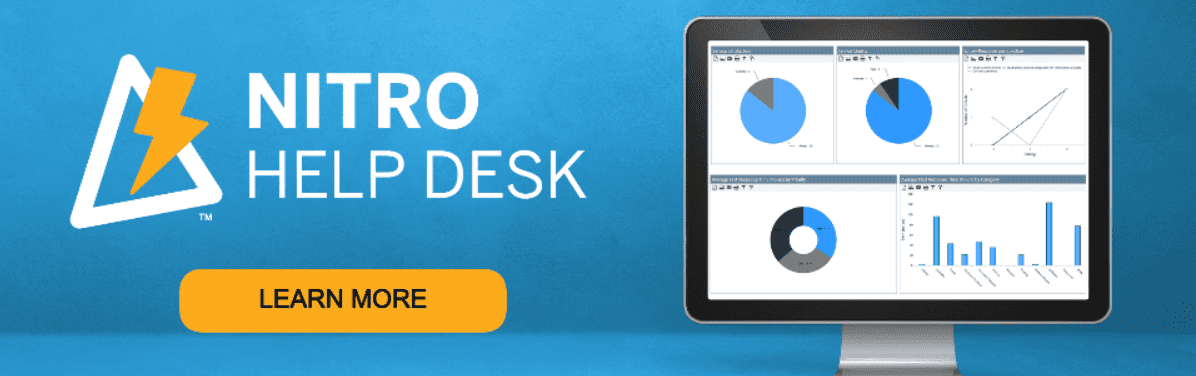
NITRO Help Desk includes built-in reporting tools and Power BI integration, giving you a clear view into how your support team is performing and where to focus improvement efforts.
5. Align IT with Business Needs
A modern IT help desk isn’t just a technical support function—it’s a strategic partner. The help desk should align with business goals, adapt to organizational changes, and support digital transformation.
Why it matters: When the help desk evolves with the business, it becomes a proactive enabler rather than a reactive service.
NITRO Help Desk is designed to scale with your organization, with support for multiple departments, integration with Microsoft Teams, and AI-driven features like NITRO Copilot that modernize how support is delivered.
Conclusion
Running a better IT help desk starts with the right strategy—and the right tools. By implementing self-service, automation, structured processes, and performance tracking, your IT team can transform from a bottleneck into a business accelerator.
Looking to upgrade your help desk without overcomplicating things? NITRO Help Desk offers all the functionality you need—at a cost and complexity level that makes sense.
Are you ready to make your IT help desk a true asset to your organization?
Request more info here:
Privacy Notice: By submitting this form, you consent to Crow Canyon Software collecting and processing your personal information to respond to your inquiry. Do not include sensitive health or personal data unless specifically requested.
Frequently Asked Questions
What are the most important IT help desk best practices?
The most important IT help desk best practices are making it easy to request support, standardizing ticket intake, maintaining a useful knowledge base, prioritizing tickets by impact and urgency, establishing SLAs, automating repetitive processes, measuring meaningful KPIs, addressing recurring problems, training technicians, and using AI where it provides measurable value.
How do you run an effective IT help desk?
To run an effective IT help desk, establish a consistent process for submitting, categorizing, prioritizing, assigning, resolving, and tracking tickets. Build a knowledge base around recurring issues, establish SLAs, automate predictable tasks, measure meaningful KPIs, and regularly analyze ticket data to improve the underlying support process.
What are the most important IT help desk metrics?
Important IT help desk metrics include ticket volume, tickets per user, first response time, resolution time, first-contact resolution, reassignment rate, SLA compliance, backlog, self-service or deflection rate, and customer satisfaction.
The most important metrics depend on what decisions the IT team needs to make.
What is first-contact resolution?
First-contact resolution, or FCR, measures the percentage of support requests resolved during the first interaction with the help desk without requiring additional follow-up or escalation.
A high FCR can indicate effective intake, technician knowledge, and access to the information needed to resolve common issues.
What is an SLA in an IT help desk?
An SLA, or service-level agreement, defines the expected response and resolution times for a support request.
IT help desks commonly use different SLA targets based on ticket priority, business impact, request type, or other organizational requirements.
How can an IT help desk reduce ticket volume?
An IT help desk can reduce ticket volume by addressing recurring problems, improving its knowledge base, providing self-service, automating routine requests, improving documentation, and fixing the underlying causes of frequently reported issues.
The objective should not be to make it difficult to submit tickets. It should be to eliminate tickets that do not require technician involvement.
Should an IT help desk use AI?
AI can be useful when it is applied to a well-organized help desk.
Good starting points include ticket summarization, knowledge search, suggested responses, categorization, prioritization, and technician assistance.
Organizations should also evaluate how AI handles support data, where information is processed, and what human oversight is required.
Can Microsoft 365 be used for an IT help desk?
Yes. Microsoft 365 provides tools such as SharePoint, Microsoft Lists, Teams, Outlook, Power Automate, and Power Apps that can be combined to support IT help desk processes.
However, building a complete help desk may require additional capabilities for ticket management, routing, SLAs, escalations, reporting, self-service, and knowledge management.
What should I look for in IT help desk software?
Look for ticket management, structured intake, automated routing, prioritization, SLA management, escalation, knowledge management, self-service, workflow automation, reporting, integrations, security, and AI capabilities that are appropriate for your organization.
Also consider how easily the system can adapt to your existing processes and how much ongoing administration it requires.
Krista White2026-10-11T11:53:30-07:00June 17th, 2025|
Krista White is Vice President of Marketing at Crow Canyon Software and has more than 26 years of experience helping organizations maximize the value of Microsoft technologies, including Microsoft 365, SharePoint, and Microsoft Teams. During her four years at Crow Canyon Software, she has helped educate business and IT leaders on business process automation, help desk software, workflow management, AI-powered productivity solutions, and digital transformation strategies.
Krista is a frequent speaker, podcast guest, and contributor on topics including SharePoint, workflow automation, AI for business, Microsoft 365 productivity, and process improvement. Through her work with organizations across industries, she shares practical insights and real-world strategies that help teams streamline operations, increase user adoption, and improve business outcomes.
As an author and industry speaker, Krista focuses on helping organizations modernize business processes, leverage emerging technologies, and get more value from their Microsoft investments.