Updated August 2026
If your organization uses Microsoft Teams for daily communication, your help desk should work with Teams, too. But not every product advertised as a “Teams-integrated help desk” provides the same experience.
Some help desk products simply place a web portal inside a Teams tab. Others send notifications to Teams while requiring users and technicians to return to a separate application to manage tickets.
True Microsoft Teams help desk software lets users and support teams interact with the help desk through Teams while maintaining the structured ticketing, workflows, SLAs, knowledge base, automation, and reporting capabilities of a dedicated help desk system.
For organizations already invested in Microsoft 365, NITRO Help Desk provides a Microsoft 365-based help desk with deep Microsoft Teams integration, including ticket submission, Teams messaging and channels, an IT support bot, business process workflows, automation, knowledge management, SLAs, reporting, and AI-powered capabilities.
If you are evaluating help desk software that integrates with Teams, here’s what to look for.
What Is the Best Help Desk Software That Integrates With Microsoft Teams?
The best help desk software for Microsoft Teams should do more than display a help desk webpage inside Teams. It should make Teams a useful part of the actual support experience.
For example, employees should be able to submit and interact with support requests through Teams, while IT staff should be able to manage tickets, communicate with users, automate processes, and receive relevant notifications without constantly switching between applications.
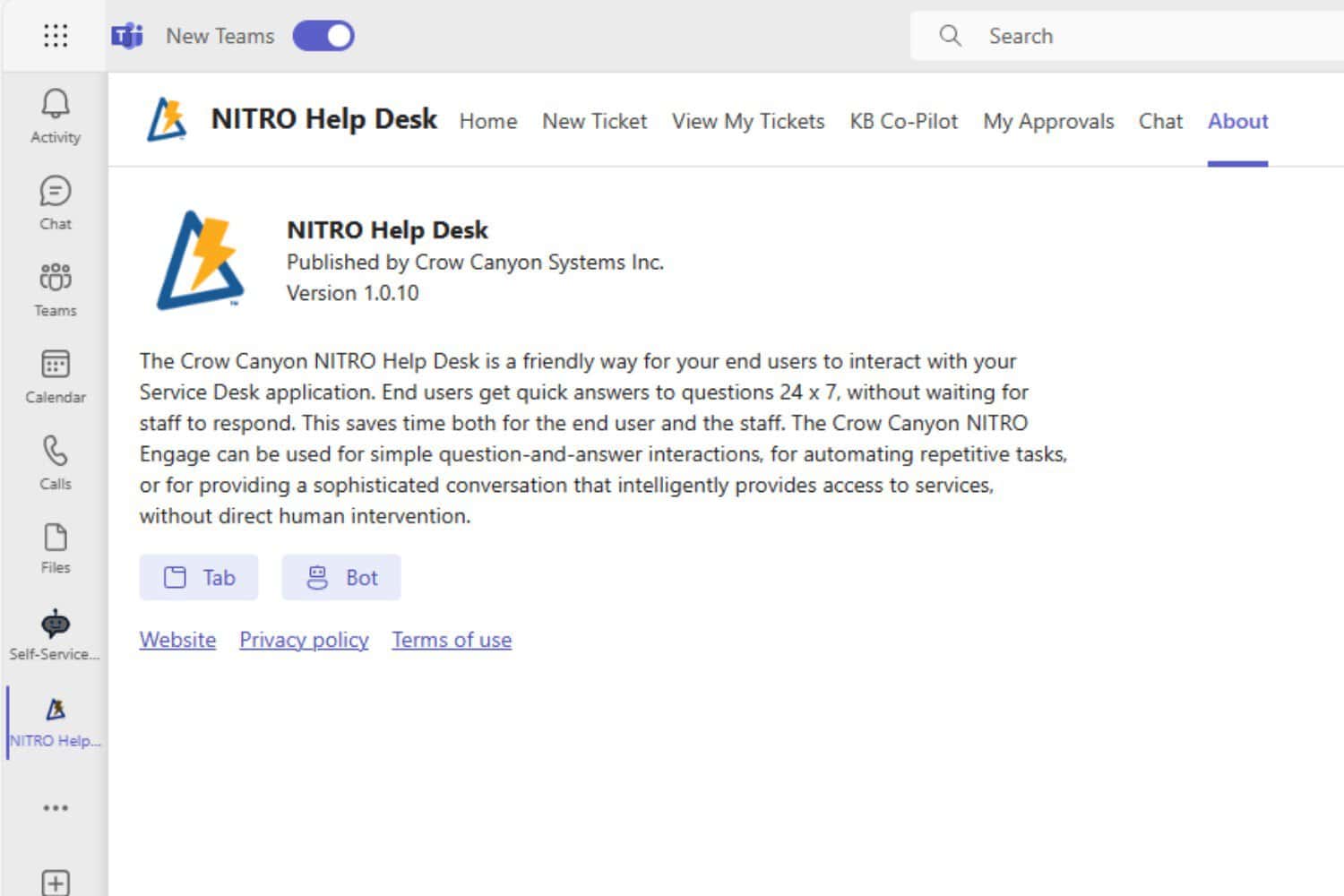
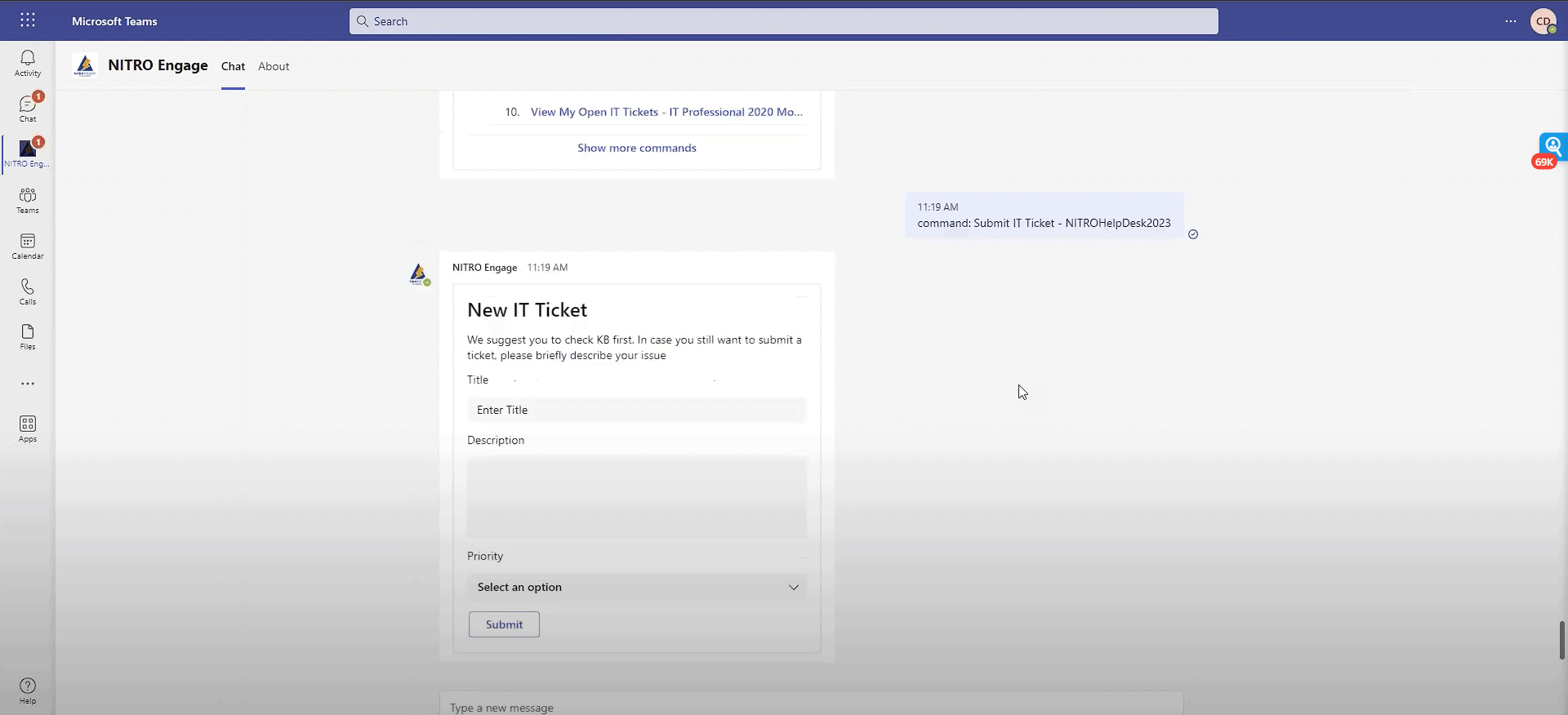
NITRO Help Desk is purpose-built for organizations using Microsoft 365, SharePoint, and Teams. Its Teams integration includes NITRO Engage, an interactive Teams-based interface that allows users to interact with NITRO applications through chat. NITRO Help Desk also supports ticket submission through Teams, Teams messaging and channels, business process workflows, and automated support processes.
For organizations that want their help desk to fit naturally into the Microsoft ecosystem they already use, this makes NITRO Help Desk a strong option for Teams-integrated IT support.
What Does “True” Microsoft Teams Integration Mean?
The phrase “Microsoft Teams integration” can mean several different things.
Microsoft Teams supports apps through capabilities such as tabs, bots, messaging extensions, and notifications. These capabilities allow applications to provide interactive experiences directly within Teams rather than simply linking users to an external website. Microsoft also supports deep links, authentication, and other capabilities that can make an application more tightly connected to the Teams experience.
For help desk software, meaningful Teams integration should make it easier for employees and support staff to complete common tasks.
Basic Teams integration
A basic integration might allow a help desk to:
- Display the help desk application in a Teams tab
- Send notifications to Teams
- Provide a link from Teams to the help desk
- Embed a web page inside Teams
These capabilities can be useful, but they do not necessarily mean that Teams is integrated into the actual ticketing workflow.
Deeper Teams integration
A more complete Teams help desk can allow users to:
- Submit support requests through Teams
- Interact with a support bot
- Receive ticket updates
- Communicate with support staff
- Access support resources
- Launch help desk functions from Teams
- Work with tickets while remaining in the Microsoft environment
For support teams, deeper integration can extend to:
- Ticket management
- Assignment
- Notifications
- Workflows
- Escalations
- Service-level management
- Knowledge management
- Business processes
The important question is not simply “Does this help desk integrate with Teams?” The better question is “What can users and technicians actually do in Teams?”
What Should You Look for in Help Desk Software That Integrates With Teams?
When evaluating Microsoft Teams help desk software, look beyond a logo that says “Teams integration.”
Here are the most important capabilities to evaluate.
1. Ticket creation directly through Teams
Employees should have a convenient way to report an IT issue or service request from the tools they already use.
If employees have to leave Teams, find a separate portal, sign in again, and navigate through multiple screens just to submit a request, the integration is not delivering its full potential.
NITRO Help Desk allows users to submit support requests through Teams as well as other channels such as web and email.
2. Ticket interaction and updates
Submitting a ticket is only the beginning.
A Teams-integrated help desk should make it easy for users to stay informed about their requests and receive relevant updates.
Look for capabilities such as:
- Ticket status updates
- Notifications
- Responses from support staff
- Ticket-related communication
- Links back to specific tickets
- Easy access to support information
3. Teams chat and support bots
A support bot can make Teams significantly more useful as a help desk interface.
Instead of requiring employees to understand the help desk application, a conversational interface can help users find information, submit requests, or get assistance through Teams.
NITRO Help Desk includes NITRO Engage, which provides an interactive chat-based interface for NITRO applications in Microsoft Teams. Crow Canyon also offers AI-powered capabilities designed to help users find knowledge and resolve common issues.
Microsoft’s Teams platform itself supports conversational bots that can interact with users in personal chats, group chats, and channels, making this type of experience a natural fit for Teams-based support.
4. Technician access to tickets
A Teams integration shouldn’t be designed only for employees submitting tickets.
IT staff should also be able to work efficiently with the resulting requests.
A strong help desk solution should provide the ticket management capabilities your service desk needs, including:
- Ticket assignment
- Prioritization
- Status management
- Escalation
- Communication
- SLA tracking
- Workflow automation
- Knowledge management
- Reporting
NITRO Help Desk provides these capabilities while leveraging Microsoft 365, SharePoint, and Teams.
5. Automated ticket routing
Manually assigning every incoming ticket creates unnecessary work for IT teams.
Look for automatic routing that can send tickets to the appropriate person or support group based on factors such as:
- Category
- Issue type
- Department
- Priority
- Workload
- Other business rules
NITRO Help Desk supports automatic ticket routing and assignment, including approaches such as round-robin or load-balanced assignment.
6. Service-level agreements and escalation
A professional IT help desk needs more than a list of open tickets.
SLA capabilities allow organizations to establish service expectations and monitor whether requests are being handled within the required timeframes.
Look for:
- SLA policies
- Priority-based service levels
- Escalations
- Overdue ticket tracking
- Service-level reporting
NITRO Help Desk includes SLA management, escalation capabilities, and reporting for tracking service performance.
7. Knowledge base and self-service
The best help desk ticket is often the one that never needs to be created.
A knowledge base can help employees find answers to common questions before contacting IT.
For Microsoft Teams users, knowledge should ideally be accessible through the same support experience.
NITRO Help Desk includes a knowledge base designed for user self-service and staff reference, along with AI-powered capabilities that can help users find relevant information.
8. Workflow automation
Many IT requests follow predictable processes.
Examples include:
- Password reset requests
- New equipment requests
- Employee onboarding
- Software requests
- Access requests
- Server changes
- Upgrades
- Patches
- Approval processes
Help desk software should allow these processes to be automated rather than relying on technicians to perform every step manually.
NITRO Help Desk supports business process workflows and automation for service requests and IT processes.
9. Microsoft 365 and SharePoint integration
If your organization already relies on Microsoft 365 and SharePoint, your help desk should fit into that environment.
A Microsoft-native approach can reduce the need to introduce another completely separate technology stack for IT support.
NITRO Help Desk leverages Microsoft 365, SharePoint, and Teams as part of its platform approach.
10. Reporting and dashboards
A help desk should provide more than ticket storage.
IT leaders need visibility into questions such as:
- How many requests are we receiving?
- What types of issues are most common?
- How quickly are tickets being resolved?
- Which tickets are overdue?
- Are SLAs being met?
- How are tickets distributed among staff?
- Which support processes need improvement?
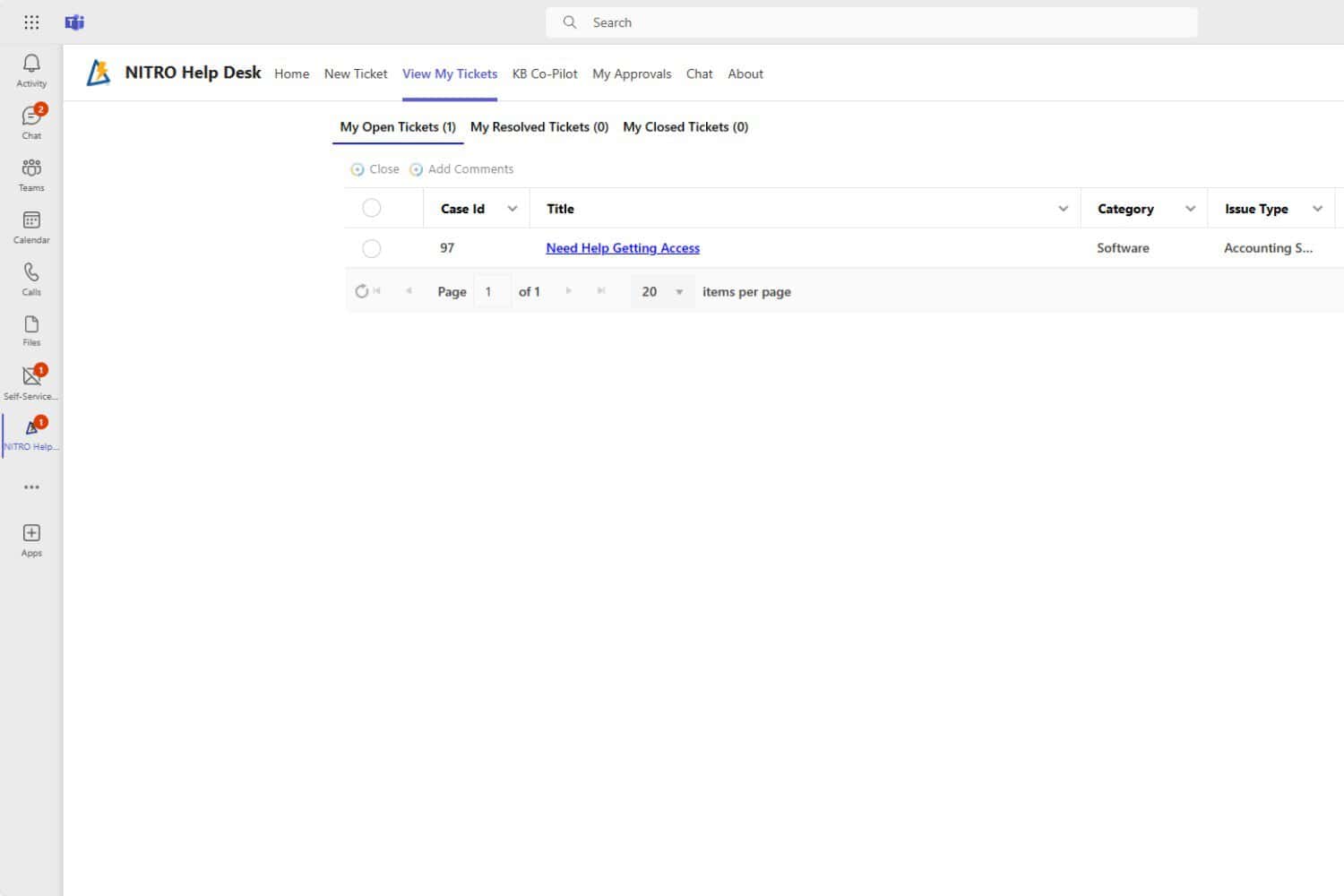
NITRO Help Desk provides reporting and dashboards for ticket status, assignment, priority, overdue requests, service levels, and other service metrics.
How Does Help Desk Software Integrate With Microsoft Teams?
There are several ways a help desk can become part of the Teams experience.
Teams tabs
A Teams tab can provide access to an application’s interface within Teams. Microsoft describes tabs as web experiences that can run inside Teams and provide access to dashboards, forms, and other application functionality.
Tabs can be useful for help desk dashboards, ticket lists, forms, knowledge bases, and other larger interfaces.
But a tab alone should not be considered the entire integration.
Teams bots and conversational support
Bots provide a conversational interface inside Teams.
For a help desk, this can be used for tasks such as:
- Answering common questions
- Finding knowledge articles
- Submitting requests
- Providing ticket information
- Sending notifications
- Guiding users through support processes
Microsoft supports bots in personal chats, group chats, and channels.
Teams messaging and notifications
Help desk systems can also use Teams messaging to notify users and support staff about important events.
For example:
- A ticket is assigned
- A ticket changes status
- A request requires approval
- An SLA is approaching
- A ticket is escalated
- A technician receives a new assignment
Microsoft’s Teams platform supports app notifications and bot-based messages as part of integrated application experiences.
Teams workflows
Teams can also become part of broader business processes.
For example, a request submitted through Teams could trigger a workflow that:
- Creates a ticket
- Categorizes the request
- Assigns it to the appropriate team
- Notifies the assigned technician
- Tracks the SLA
- Requests approval if needed
- Updates the requester
- Records the final resolution
This is where Teams integration becomes much more valuable than simply embedding a help desk webpage.
Help Desk Software vs. Using Microsoft Teams as a Help Desk
Microsoft Teams is an excellent collaboration and communication platform, but Teams by itself is not a replacement for a dedicated help desk system.
Teams gives employees a place to communicate.
A help desk gives IT a structured system for managing support.
Microsoft Teams by itself
Teams provides:
- Chat
- Channels
- Meetings
- Collaboration
- File sharing
- App integrations
A dedicated help desk integrated with Teams
A help desk adds:
- Structured tickets
- Ticket IDs
- Assignment
- Priorities
- Categories
- SLAs
- Escalations
- Automated routing
- Workflows
- Knowledge management
- Reporting
- Service history
- Resolution tracking
- Self-service
The strongest approach is therefore not necessarily Teams versus help desk software.
It is help desk software that works through Teams.
That allows employees to continue using Teams while IT gets the structure and automation required to operate a professional service desk.
What Doesn’t Count as True Microsoft Teams Integration?
Not every product that appears in the Teams app marketplace provides the same level of integration.
For example, a product may:
- Provide a link to its website
- Display a web portal in a Teams tab
- Send occasional notifications
- Require users to leave Teams to perform important actions
Those capabilities may still be useful.
But if your goal is a help desk that genuinely works with Microsoft Teams, evaluate what users can actually accomplish inside Teams.
Ask vendors:
Can employees create tickets from Teams?
Can they interact with their requests through Teams?
Can support staff manage tickets and workflows through the Teams experience?
Is there a Teams bot or conversational support experience?
Can Teams be part of automated support workflows?
Does the solution use the Microsoft 365 environment rather than simply linking to a separate application?
These questions will reveal much more about the quality of a Teams integration than the word “integrated” on a product page.
NITRO Help Desk: A Microsoft Teams-Integrated Help Desk
For organizations looking for help desk software that integrates deeply with Microsoft Teams, NITRO Help Desk is built specifically around the Microsoft ecosystem.
NITRO Help Desk combines help desk ticketing with Microsoft 365, SharePoint, and Teams to provide a unified environment for IT support.
Submit tickets through Microsoft Teams
Employees can submit support requests through Teams rather than having to navigate to a separate help desk portal.
NITRO Help Desk also supports requests through other channels, including web and email, allowing organizations to provide multiple ways for users to contact support.
Use NITRO Engage in Teams
NITRO Engage provides an interactive, chat-based interface for NITRO applications within Microsoft Teams.
This allows Teams to become a more natural front door for employee support instead of simply acting as a link to another application.
Support Teams messaging and channels
NITRO Help Desk supports Teams messaging and channels as part of its Microsoft Teams integration.
That makes it possible to incorporate communication into the support process while maintaining structured ticket records.
Automate support processes
NITRO Help Desk supports business process workflows that can automate repetitive support activities.
Instead of relying on manual follow-up, organizations can build processes around ticket creation, assignment, notifications, approvals, escalations, and other actions.
Manage SLAs and escalations
IT teams can establish service-level policies, prioritize tickets, track service performance, and escalate requests that require attention.
Provide self-service
NITRO Help Desk includes a knowledge base that can help employees find answers without opening a ticket.
Its AI-powered capabilities can also help users and support staff find relevant knowledge more efficiently.
Add AI-powered support
Modern help desks increasingly use AI to reduce repetitive work for IT teams.
NITRO Help Desk includes AI capabilities such as:
- Knowledge Base Copilot
- AI-powered first responder capabilities
- Ticket summarization
- Automatic categorization
- Automatic prioritization
- Sentiment analysis
- Intelligent routing
- Staff assistance
These capabilities can help organizations automate routine support activities while giving IT staff faster access to relevant information.
Who Should Consider a Microsoft Teams-Integrated Help Desk?
A Teams-integrated help desk is particularly useful for organizations that already rely heavily on Microsoft 365 and Teams.
It can be a strong fit for:
- Corporate IT departments
- Government organizations
- Higher education
- Healthcare organizations
- Financial services
- Manufacturing
- Housing organizations
- Professional services organizations
- Organizations with Microsoft 365-based workflows
It is especially useful when employees already spend much of their workday in Teams and IT wants to reduce the friction involved in submitting and following up on support requests.
Why Use a Microsoft 365-Native Help Desk?
Choosing a help desk that fits your existing Microsoft environment can simplify the user experience and reduce technology sprawl.
With a Microsoft 365-oriented help desk, organizations can build support processes around tools and platforms they already use.
NITRO Help Desk is built around Microsoft 365, SharePoint, and Teams, providing a help desk environment that fits into the broader Microsoft ecosystem.
For organizations already standardized on Microsoft technology, this can be an important consideration when comparing a Microsoft-native help desk with standalone IT service management platforms.
See What a Microsoft Teams-Integrated Help Desk Can Do
If your employees already use Microsoft Teams every day, your help desk should meet them where they work.
NITRO Help Desk combines structured ticketing, Microsoft Teams integration, workflow automation, knowledge management, SLAs, reporting, and AI-powered support in a Microsoft 365-based platform.
See how NITRO Help Desk can help your organization deliver faster, more efficient support through Microsoft Teams.